

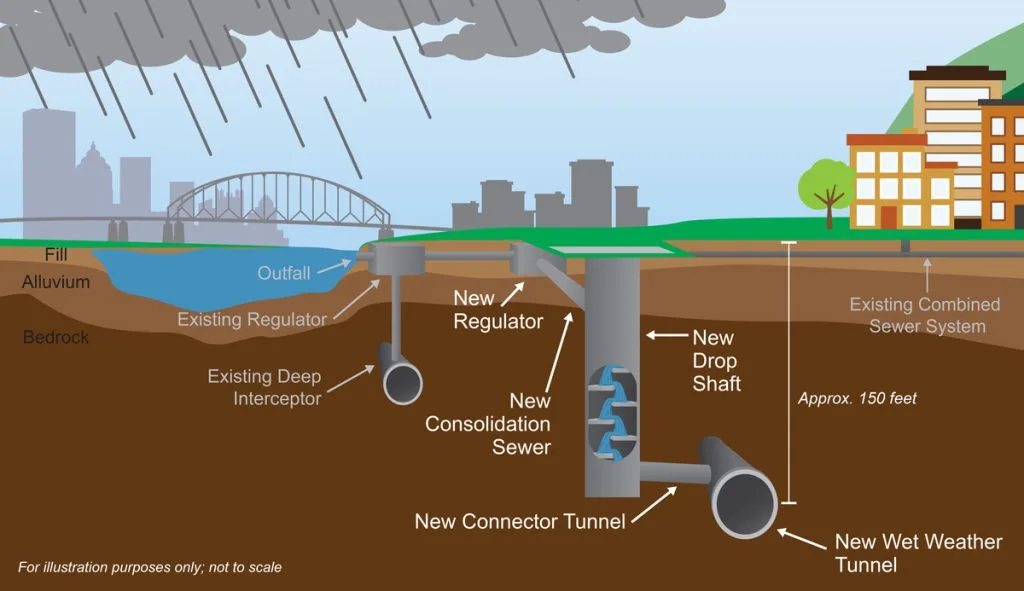
A project designed to drastically reduce sewer overflows and improve and protect the region’s rivers and streams has moved from the planning phase to the construction phase.
The Allegheny County Sanitary Authority (ALCOSAN) on Monday officially issued a notice to proceed for its Ohio River Tunnel, the first part of the authority’s Regional Tunnel System, which is a pillar of ALCOSAN’s Clean Water Plan.
The Clean Water plan was adopted to meet federal requirements and to improve and protect the region’s waterways.
Steel City Tunnel Partners will construct the project, which includes two key features in McKees Rocks.
One site, located at the corner of West Carson Street and Chartiers Avenue, will include construction of a drop shaft approximately 50 feet in diameter and 150 feet deep as well as modifications to the outfall — the point where water is discharged from the sewer system into the river.
That site will be the starting point for the Chartiers Creek Tunnel, a 14-foot diameter branch tunnel that will run approximately 4,500 feet deep below the Ohio River and connect to ALCOSAN’s larger Ohio River Tunnel.
The second McKees Rocks site is at the corner of Ella and Shingiss streets in the Bottoms. This site will include the construction of a drop shaft about 25 feet in diameter and 150 feet deep, along with a regulator and a connector tunnel.
A regulator is a control structure in the sewer system that manages how wastewater flows between pipes and determines when excess flow is diverted to an outfall during storms.

Work on both McKees Rocks sites is expected to begin sometime this year but an ALCOSAN spokesperson said the project contractor — a partnership between The Lane Construction Corp. and Brayman Construction Corp. – hasn’t yet provided a definitive construction schedule.
That schedule will be shared with the public as soon as it’s provided and approved.
Brayman-Lane was awarded the approximately $1 billion contract at ALCOSAN’s April 2026 board meeting.
Construction of the Ohio River Tunnel is scheduled to take nearly 6½ years, ending in late 2032.
Work on the West Carson Street/Chartiers Avenue site is expected to continue until late 2029. Following construction, ALCOSAN will maintain a permanent easement so it can access and maintain the facilities. The rest of the site will be restored to its current condition.
Construction of the drop shaft and connector tunnel at the Ella/Shingiss site won’t be completed until late 2030. ALCOSAN said that because this construction site is in a residential area, it will work with the contractor or contractors to minimize noise, dust and vibration impacts.
Once the Ohio River Tunnel is complete, it will connect to a larger regional tunnel system designed to capture and convey excess wet weather flows to ALCOSAN’s wastewater treatment plant.
The Ohio River Tunnel is the first of ALCOSAN’s three planned tunnels and ALSCOSAN officials say the system will play a critical role in reducing sewer overflows and improving water quality throughout the region.
The full tunnel system will include more than 16 miles of deep tunnels and supporting infrastructure constructed approximately 120 to 150 feet below ground.
The tunnels make up one of four so-called pillars in ALCOSAN’s Clean Water Plan, the goal of which is to essentially keep sewage out of local waterways — except in extreme storm conditions — by expanding system capacity and modernizing infrastructure across the entire region.

When the project is finished, rather than overflows making their way into local waterways such as Chartiers Creek and the Ohio River, they will be directed to large underground tunnels and eventually make their way to an expanded ALCOSAN treatment plant.
Arletta Scott Williams, ALCOSAN’s executive director, said Monday that Monday’s notice to proceed “marks the transition from preparation to construction on the Regional Tunnel System.
“This is a momentous milestone not just for our Clean Water Plan, but protecting our region’s waterways for future generations,” Williams added.
The Clean Water Plan was a source of contention for the borough of McKees Rocks, which became embroiled in a lawsuit with ALCOSAN over the latter’s purchase of the former Crivelli Chevrolet dealership, which closed in late 2019. Ultimately, the two sides came to an agreement in which the authority would pay the borough the equivalent of the tax revenue it would have received had the dealership remained privately owned.
According to its website, ALCOSAN’s Clean Water Plan will reduce the amount of combined sewage overflow by 7 billion gallons per year and eliminate sanitary sewage overflows. In addition to its regional tunnel system that includes the Ohio River Tunnel, the plan’s three pillars are:
- Regionalization — ALCOSAN is working with municipalities to take ownership of trunk sewers and related facilities to create a streamlined collection system.
- Plant Expansion — The Clean Water Plan calls for ALCOSAN’s Northside plant to expand. This additional capacity will help reduce the number of overflows caused by excess stormwater.
- GROW/Source Control – ALCOSAN created the Green Revitalization of Our Waterways (GROW) program to reduce excess water from entering an already overloaded sewer collection system.
Most of the costs associated with the Clean Water Plan will be borne by ratepayers. The authority plans to implement multi-year rate increases through 2036 and already implemented 7% annual increases from 2022 through 2026. ALCOSAN plans to release its new five-year rate structure later this year, according to its website.






Leave a Reply